deetech Ranks #1 on the Podonos Audio Deepfake Detection Benchmark
deetech tops the independent Podonos audio deepfake benchmark: 99.56% accuracy on 4,524 clips, with just 0.4% of real audio flagged.

deetech is ranked #1 of 23 systems on the Podonos audio deepfake detection benchmark, with 99.56% accuracy. Podonos scores every entry against labels only it holds, and publishes the full ranking openly.
The Results
- 99.56% accuracy across 4,524 real and fake clips.
- 0.4% of real audio flagged as fake. That’s the false positive rate.
- 0.4% of fakes missed. That’s the false negative rate.
- 50 ms to score a clip on average, self-reported, as the board notes for vendor entries.
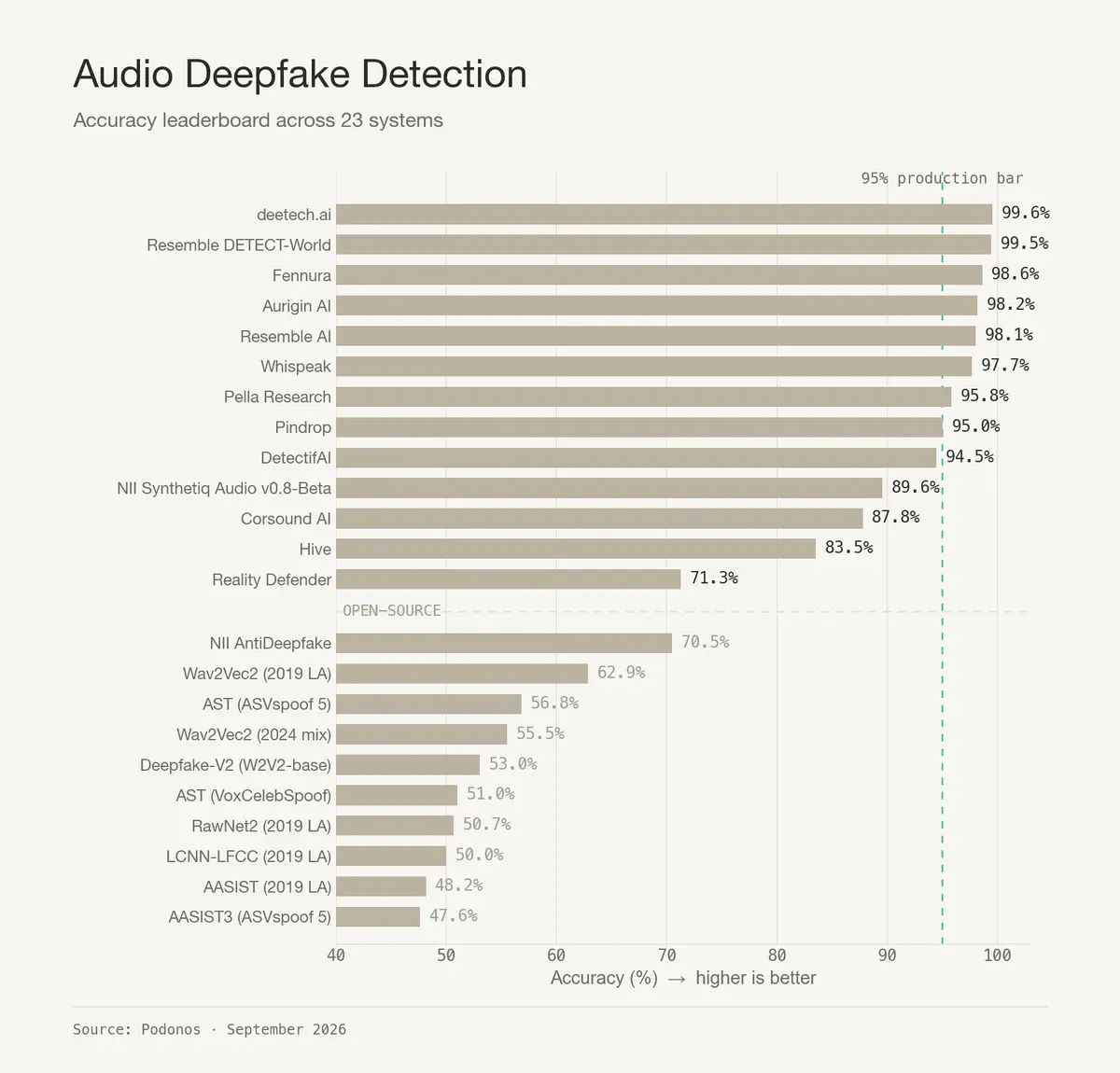
Chart: Podonos, September 2026. From Podonos’s announcement, Audio deepfake detection benchmark: deetech.ai takes the top spot.
How the Benchmark Works
Podonos runs the benchmark as a neutral evaluation on a fixed set of real and fake clips. Vendors run their systems and submit their verdicts. Podonos keeps the labels and computes the scores, so no one can tune to the answer key.
Why Both Error Rates Matter
Accuracy alone can hide a lopsided detector. Two numbers decide how a detector behaves in production.
False positives cost trust. Each one is a real person treated as a fake: a genuine claim delayed, a real customer challenged. At 0.4%, four in every 1,000 genuine recordings get a second look.
False negatives cost money. Each one is a fake that gets through. At 0.4%, 996 in every 1,000 fakes are caught.
Our two rates are equal, so neither is bought at the other’s expense.
A Big Step in Generalization
Deepfake detectors share a well-known weakness: they learn the generators they were trained on, then stumble on the next one. New voice models appear every month, and scammers use whichever is newest.
Our new model architecture is a big step on exactly that problem. It’s built for generalization: staying accurate on new deepfakes and spoofing techniques, not only the ones it has already seen. Podonos adds outside proof: first place among 23 systems on a test we didn’t build, scored against labels we never saw.
Fast Enough for Live Calls
At 50 ms per clip, detection keeps pace with a live conversation. That matters wherever a decision has to happen while someone is still talking: on a contact center line, in a video meeting, or during a claims call. Live call and meeting detection are available on deetech™ Enterprise plans.
Open to Independent Testing
Public benchmarks keep the industry honest, and we want more of them. We’re open to any external, impartial benchmark of deetech™, across audio, images, video, and documents, including tests where you run deetech yourself on data we’ve never seen.
If you run an evaluation, or want to test deetech on your own data, contact us at sales@deetech.ai.
The Bottom Line
#1 of 23 systems on an independent benchmark, with 0.4% of real audio flagged, 0.4% of fakes missed, and the speed for live use. The full ranking and method are public on GitHub.