How AI-Generated Property Damage Photos Fool Claims Systems: A Technical Analysis
How AI-generated property damage images differ from real photos: pixel, frequency-domain, compression and metadata signatures, and how detection works.
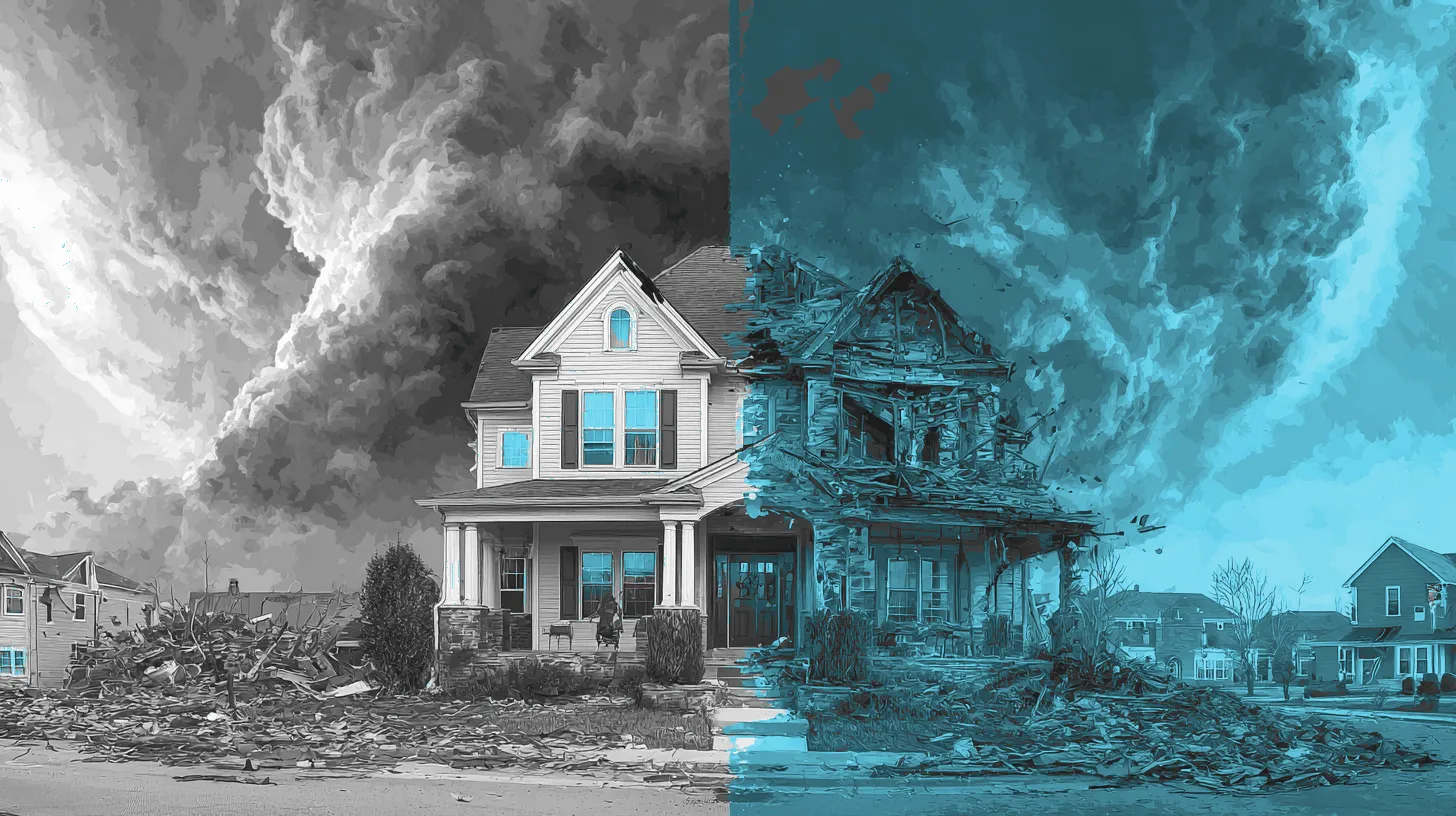
The property damage photograph is the foundational evidence in most insurance claims. A water-stained ceiling. A collapsed fence. A fire-scarred wall. These images drive claims decisions worth thousands to hundreds of thousands of dollars — and most claims systems have no built-in mechanism to verify whether they depict reality.
AI image generation has reached a point where synthetic property damage photographs can pass visual inspection by trained claims adjusters. But “visually convincing” is not the same as “forensically identical.” AI-generated images differ from genuine photographs in measurable, detectable ways — if you know where to look.
This article provides a technical analysis of the signatures that distinguish AI-generated property damage images from genuine photographs, covering the pixel level, frequency domain, compression characteristics, metadata layer, and model-specific fingerprints.
Why Property Damage Is Different from Face Deepfakes
Most deepfake detection research and commercial tooling focuses on faces. Face-swap detection, face-generation detection, and facial manipulation detection dominate the field because faces are the primary target in political disinformation, non-consensual pornography, and identity fraud.
Property damage images present a fundamentally different detection challenge.
No biological constraints. Face detection leverages the fact that human faces have predictable geometry — bilateral symmetry, consistent proportions, expected skin texture. Property damage has no such constraints. A collapsed roof can look like almost anything. There’s no “expected” geometry to anchor analysis.
Higher tolerance for irregularity. In face generation, viewers notice subtle asymmetries, unusual skin texture, or inconsistent lighting because we’re biologically attuned to face perception. Property damage is inherently irregular — broken materials, random debris patterns, chaotic destruction. Artifacts that would be immediately noticeable in a face image may be imperceptible in a damage image.
Different image characteristics. Property photos are typically taken with smartphone cameras in challenging conditions — poor lighting, awkward angles, mixed indoor/outdoor exposure. They’re often compressed, resized, and transmitted through messaging apps. This baseline “messiness” provides cover for generation artifacts.
Less training data. Generative models are primarily trained on internet image datasets (LAION, ImageNet derivatives) that contain vastly more “normal” images than damage images. Fine-tuning or prompting for damage-specific content may produce subtler generation errors as the model extrapolates beyond its strongest training distribution.
These differences mean that face-focused detectors are not designed for property damage imagery. Detection for claims work has to cover whole-scene generation and localized edits to ordinary scenes, not just faces.
Pixel-Level Analysis
At the pixel level, AI-generated images exhibit several detectable characteristics.
Texture inconsistency
Genuine photographs of damaged property contain complex texture at multiple scales. A water-damaged wall, for example, shows the base wall texture (plaster, brick, timber), the water damage overlay (staining patterns, mineral deposits, paint delamination), and environmental context (dust, debris, biological growth).
AI-generated textures can fail to maintain consistency across scales. The macro-level appearance may be convincing — the wall looks water-damaged from normal viewing distance. But at the pixel level, the fine texture lacks the multi-layered complexity of real damage. Water staining in real images shows gradual transitions with irregular boundaries following the physics of capillary action. AI-generated staining tends to show smoother gradients with less physical plausibility at high magnification.
Detection approach: Multi-scale texture analysis using Gabor filter banks or wavelet decomposition. Compare texture complexity metrics (entropy, fractal dimension, lacunarity) across spatial scales. AI-generated images often show lower texture complexity at fine scales, relative to coarse scales, than genuine photographs — a tendency, not a rule, and one that compression can mask.
Edge rendering
The boundary between damaged and undamaged areas in a genuine photograph is determined by physical processes — the actual edge where fire charring ends, where water reached, where structural failure occurred. These edges are complex, irregular, and physically motivated.
AI generation models, particularly diffusion models using inpainting workflows, create boundaries between generated and original content that exhibit characteristic edge properties. These include softer transitions than physically expected (the model blends rather than creating hard boundaries), inconsistent edge sharpness (some boundaries are sharper than others in ways that don’t correlate with the physical scenario), and halo artifacts — subtle brightness or color shifts along the boundary between inpainted and original regions.
Detection approach: Edge detection (Canny, structured edge detection) followed by analysis of edge characteristics in damage boundary regions. Compare edge profiles against a database of genuine damage edge characteristics for the claimed damage type.
Color channel inconsistencies
Most camera sensors record only one color per pixel through a color filter array (typically a Bayer pattern); the camera then interpolates the missing values (“demosaicing”). That interpolation leaves periodic correlations between neighboring pixels and between the red, green and blue channels. AI generators produce all three channels directly, so their output lacks these demosaicing traces — or shows inter-channel statistics that differ from those of a real camera pipeline.
Material appearance matters too. Charred timber, oxidized metal and water-stained plaster have characteristic color and texture statistics that generators may approximate only loosely at the pixel level.
Detection approach: Test for demosaicing (color filter array) traces and analyze the statistical relationship between color channels — for example, with color co-occurrence matrices compared against reference distributions from genuine photographs. Missing or inconsistent camera-pipeline traces are a signal worth escalating, not proof on their own: heavy compression and resizing also erode them.
Frequency Domain Analysis
The frequency domain — the image’s representation in terms of spatial frequencies rather than pixel intensities — reveals generation artifacts invisible in normal viewing.
GAN-specific spectral signatures
Generative Adversarial Networks (GANs) produce images through transposed convolution layers that create periodic patterns in the frequency domain. These patterns, visible in the Fourier transform of the image, appear as regular grid-like artifacts at specific frequencies corresponding to the GAN architecture.
Frank et al. (2020) showed that GAN-generated images carry spectral artifacts, largely caused by upsampling, that are consistent within a given architecture and differ between architectures. Later work extended the analysis to newer GAN families, some of which were designed in part to reduce these artifacts.
For insurance applications, GAN-based property damage generation — while less common than diffusion-based generation in 2026 — still appears in fraud attempts using older or more accessible tools.
Detection approach: Compute the 2D Discrete Fourier Transform (DFT) of the image. Analyze the magnitude spectrum for periodic artifacts, particularly in the high-frequency region. Apply spectral analysis classifiers trained on known GAN architectures. Azimuthal averaging of the magnitude spectrum provides a 1D representation that highlights periodic anomalies.
Diffusion model spectral characteristics
Diffusion models (Stable Diffusion, DALL-E, Midjourney and others) generate images through iterative denoising, and their frequency-domain characteristics differ from those of GANs. Natural photographs follow a fairly regular power-law falloff — power drops roughly as 1/f² with spatial frequency. Diffusion outputs often deviate from that curve, especially in the mid-to-high frequencies. The decoder that maps a latent image back to pixels can also leave faint periodic traces, and the denoising process leaves a residual noise structure that differs from real camera sensor noise. Newer autoregressive image generators add yet another family of signatures, which is one reason detectors need continuous retraining.
Corvi et al. (2023) showed that diffusion-model outputs also carry spectral artifacts — generally weaker and less regular than GAN grid peaks — and that detectors trained only on GAN images generalize poorly to them. The same line of research found that compression and resizing degrade these traces, which is why real-world claims media is harder than clean lab data.
Detection approach: Compute the radially averaged power spectral density (PSD) of the image, fit it against the expected power-law model of natural images, and examine the residuals for deviations characteristic of generation. Wavelet-based analysis (for example, Daubechies wavelets) adds frequency-localized information. Sensor-noise analysis is complementary: a genuine camera leaves a photo-response non-uniformity (PRNU) pattern that can be matched against other photos from the same device, while synthetic content carries no such pattern.
Inpainting boundary detection
When fraudsters use inpainting to add damage to a genuine property photo, the boundary between genuine and generated content creates a detectable discontinuity in the frequency domain. The genuine region has frequency characteristics reflecting real camera capture. The inpainted region has frequency characteristics reflecting the generation model. The boundary between them creates a spatial transition in spectral properties.
Detection approach: Sliding window spectral analysis across the image. Compute local spectral features in overlapping patches and identify spatial transitions in spectral characteristics. Regions where spectral properties change abruptly — not corresponding to genuine image content boundaries — indicate inpainting boundaries.
Compression Artifact Analysis
JPEG compression is ubiquitous in insurance claims photography. Understanding how compression interacts with AI-generated content reveals additional detection opportunities.
Double compression and JPEG ghosts
A camera JPEG is compressed once, at capture. If someone edits that photo — adding, modifying or inpainting a region — and saves it again as JPEG, most of the image has now been compressed twice, while newly generated content has been compressed only once (at the final save). Double compression leaves characteristic periodic patterns in the histograms of the DCT coefficients (double-quantization artifacts); regions that lack them, or show a different pattern, stand out.
A related technique is “JPEG ghost” analysis. If a pasted region was last compressed at a different quality than the rest of the image, re-saving the image at a range of qualities and measuring the difference from the original reveals a “ghost”: the pasted region’s difference drops to a minimum at its own earlier quality, not at the quality where the rest of the image minimizes.
Detection approach: Model the DCT-coefficient histograms block by block to map regions with and without double-quantization traces. For ghost analysis, re-compress the suspect image at quality factors from roughly 50 to 99, compute per-pixel (or per-block) differences against the original for each, and look for regions whose minimum difference occurs at a different quality factor from the rest of the image.
Block artifact inconsistency
JPEG compression operates on 8×8 pixel blocks. The block grid alignment is determined at the time of initial compression. When content is generated by AI and inserted into a genuine photograph, the inserted content may not align with the original JPEG block grid.
Even if the final image is re-compressed (aligning everything to a single block grid), residual evidence of the original grid misalignment can sometimes be detected through analysis of block boundary discontinuities.
Detection approach: Analyze the 8×8 block structure of the image. Compute the Block Artifact Grid (BAG) for different regions. Regions with inconsistent grid alignment or inconsistent block artifact intensity indicate composition from multiple sources.
Quantization table analysis
JPEG compression uses quantization tables that determine how strongly each frequency component is compressed. Different cameras, software applications, and platforms use different tables, so the tables embedded in the file should be plausible for the claimed source.
An image saved by a Python script typically carries standard library tables (for example, Pillow’s defaults), which differ from the tables a phone’s camera pipeline writes. If the EXIF data claims a specific phone model but the quantization tables match a generic software library, the image has at minimum been re-processed outside the camera. Two caveats keep this honest: recent iPhones save photos as HEIC by default and convert to JPEG on export, and many claims portals and messaging apps recompress uploads. A mismatch is a flag for review, not proof of fabrication.
Detection approach: Extract the quantization tables from the JPEG file. Compare them against a reference set of tables from cameras, smartphones, software applications and common upload platforms. Flag mismatches between the claimed source device (from EXIF data) and the actual tables, and weigh them alongside the file’s other history.
Metadata Forensics
The metadata layer of an image file provides rich forensic information — and rich opportunities for detecting fabrication.
EXIF data integrity
Genuine smartphone photographs contain extensive metadata: dozens of standard EXIF fields covering device identification, lens parameters, exposure settings and GPS data, plus manufacturer-specific “maker notes” describing the processing pipeline.
AI-generated images have no natural EXIF data. Fraudsters who inject EXIF data to simulate smartphone capture face the challenge of replicating all relevant fields consistently. Common inconsistencies include missing fields that real devices always populate, field values that are inconsistent with each other (focal length that doesn’t match the claimed lens), GPS precision that doesn’t match the claimed device’s GPS capabilities, software version strings that don’t correspond to any real firmware release, and timestamp formatting inconsistencies.
Detection approach: Parse all EXIF fields and validate against a device-specific profile database. For each claimed device model, maintain a profile of expected fields, value ranges, and inter-field relationships. Score the EXIF data against the profile, flagging missing fields, out-of-range values, and inconsistencies.
Thumbnail analysis
Many cameras embed a thumbnail image in the EXIF data at the time of capture. If the main image is later manipulated, the thumbnail may still reflect the original, unmanipulated content. Comparing the thumbnail against the main image can reveal manipulation.
Detection approach: Extract the embedded EXIF thumbnail and compare against a downscaled version of the main image. Significant differences — particularly in damage regions — indicate post-capture manipulation.
Temporal and geographic consistency
Metadata includes timestamps and GPS coordinates that can be validated against external data sources. A photo claiming to show flood damage on March 15 at GPS coordinates in Brisbane should be consistent with Bureau of Meteorology records showing flooding in that area on that date, the sun position implied by shadows in the image matching the claimed time and location, and weather conditions visible in the image (cloud cover, rain, lighting) matching recorded conditions.
Detection approach: Cross-reference claimed timestamp and GPS against weather APIs, astronomical calculations (sun position, shadow analysis), and disaster impact data. Flag inconsistencies between metadata claims and image content.
Model-Specific Fingerprints
Different AI generation models leave characteristic signatures — traces that research shows can often be associated with a model family, although attribution is probabilistic, not proof of which tool was used.
Stable Diffusion signatures
Stable Diffusion and its variants generate in a compressed latent space and decode to pixels through a VAE (variational autoencoder). The decoder introduces subtle but consistent patterns, sometimes described in the literature as a latent-space fingerprint. Research reports that these patterns:
- Are fairly consistent across prompts and generation settings
- Differ between model versions that use different decoders
- Often survive moderate JPEG compression
- Weaken under resizing, cropping and repeated recompression, so they cannot be relied on alone
Midjourney signatures
Midjourney’s internals are not public, but its outputs tend to show consistent color, aesthetic and fine-texture tendencies that classifiers trained on known Midjourney images can learn.
Fine-tuned model signatures
Fraudsters may use fine-tuned models trained on property damage images. Fine-tuning typically modifies rather than eliminates the base model’s traces, so fine-tuned outputs often still carry an attenuated base-model signature.
Detection approach: Train classifier networks on outputs from known model families. Use both spatial and frequency domain features. Maintain a model signature database that is continuously updated as new models are released. This is a core requirement — the arms race between generation and detection demands continuous model coverage expansion.
Laundering Resistance
Sophisticated fraudsters attempt to remove AI generation signatures through various laundering techniques. Understanding these techniques is essential for building robust detection.
Screenshot laundering
Taking a screenshot of the generated image on a real device creates a new file and discards the original metadata. But screenshots carry their own tell-tale profile: no lens or exposure fields, dimensions that match a screen, and often a PNG container. Pixel-level and frequency-domain generation signatures can also persist through the screenshot, although display scaling may weaken them.
Re-photography
Displaying the generated image on a screen and photographing it with a real camera introduces genuine optical characteristics (lens distortion, depth of field, moiré patterns from screen pixel interaction) and genuine metadata. This is one of the most effective laundering techniques, as it fundamentally changes the signal characteristics.
Detection relies on identifying screen-display artifacts — moiré patterns, pixel grid interference, color gamut limitations of the display, and non-uniform brightness from the screen backlight.
Social media laundering
Uploading to and downloading from social media platforms (Facebook, Instagram) strips metadata and applies platform-specific compression and processing. Platform processing is fairly well characterized and can be partly accounted for, and some pixel-level generation signatures survive it — but each round of platform compression makes detection harder.
Multi-generation laundering
Running an AI-generated image through a second AI processing step — for example, using an AI upscaler or AI enhancement tool — modifies the original generation signatures. This creates a more complex forensic challenge, as the image now carries signatures from two AI systems. Detection models must be trained on multi-generation scenarios.
Detection approach: Robust detection must operate on features that survive laundering. Deep learned features from classifiers trained on laundered examples provide better resilience than handcrafted features. Ensemble approaches combining multiple detection methods provide defense in depth — laundering that defeats one detection method may not defeat all of them.
Practical Detection Pipeline for Insurance
Translating these technical capabilities into an operational detection pipeline for insurance requires attention to throughput, integration, and actionability.
Ingestion
Every image uploaded through claims portals, mobile apps, email, or any digital channel is captured and queued for analysis. The ingestion layer normalizes image formats and extracts metadata before analysis.
Tier 1: Fast screening
Lightweight models analyze each image for high-confidence AI generation indicators. This includes frequency domain anomaly scores, EXIF consistency checks, compression artifact analysis, and a pre-trained classifier providing a deepfake probability score. Images scoring below the suspicion threshold proceed normally. Images scoring above receive enhanced analysis.
Tier 2: Enhanced analysis (seconds to minutes)
Flagged images receive deeper analysis with full model fingerprint analysis, cross-claim image similarity comparison, metadata cross-referencing against external data sources, and multi-model ensemble scoring.
Tier 3: Forensic investigation (hours)
High-confidence detections or high-value claims receive comprehensive forensic analysis including detailed spectral analysis and report generation, manual expert review of automated findings, evidence package preparation for SIU, and analysis designed to support expert legal review and regulatory reporting.
Output integration
Detection results are delivered to the claims management system through an API or webhook integration that the insurer builds. Each image receives a confidence score, a classification (genuine, suspicious, likely synthetic), contributing factors (which detection signals triggered), and recommended action (proceed, review, escalate).
This integration enables automated workflow routing that places detection into the claims process rather than alongside it.
Conclusion
AI-generated property damage photographs are visually convincing. They fool human reviewers. They pass basic claims system checks. But they are not forensically identical to genuine photographs.
The signatures are there — in the frequency domain, in the compression artifacts, in the metadata inconsistencies, in the model-specific fingerprints. Detecting them requires layered forensic analysis built around claims workflows, deployed at the speed and scale that claims processing demands.
The generation models will improve. The signatures will become subtler. But as long as AI-generated images are generated rather than photographed, they will tend to differ from real camera captures in measurable ways. The task is ensuring that detection keeps pace with generation — a continuous technical challenge, not a solved problem.
To see how deetech™ helps insurers and claims teams screen property-damage photos for AI generation and manipulation, visit our solutions page or request a demo.